What does it mean to take up the shield of faith when trouble is already coming your way? Many Christians believe God is trustworthy, yet struggle to act on His Word when fear, temptation, or pain becomes intense. The question is not simply whether we agree with God. It is whether His truth shapes our next step.
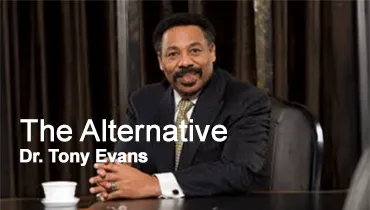
In “The Shield of Faith,” Dr. Tony Evans, founder of The Urban Alternative, teaches from Ephesians 6 that faith means acting on what God has said. The shield is not positive thinking, denial, or confidence in our own strength. It is active trust in God, grounded in His truth and expressed through obedience.
Through illustrations involving distorted images, a doctor’s prescription, and an injured gymnast, Evans shows why faith must reach beyond what we can see. His central challenge is practical: when circumstances and God’s Word seem to point in different directions, which one will guide your response?
The shield of faith protects believers as they face spiritual opposition. This message explains how faith connects God’s truth with everyday obedience, especially when feelings and circumstances make that obedience difficult.
Evans opens with a familiar sight: silverware in a glass of water can appear bent even though it remains straight. Refraction changes how the object looks. The problem is not the silverware itself, but the distorted image reaching our eyes.
He uses that picture to describe a world that often makes wrong look right and right look wrong. What seems obvious may not tell the whole story. Christians therefore need more than their first impression when deciding how to respond to life.
In Ephesians 6:12, Paul identifies spiritual enemies behind the church’s struggle. His point directs believers away from treating people as their ultimate enemy. Human conflict is real, but the battle extends beyond what human senses can detect.
This does not mean that every difficulty can be traced to a particular demonic act. It means that Christians should not understand life as though the physical world were all that exists. Evans also draws on the believer’s position with Christ in the heavenly places, described in Ephesians 2:6. Our relationship with Christ changes where we begin when interpreting trouble.
Faith begins with God’s perspective rather than appearances alone. When conflict arises, the first question is not merely how to defeat the person across from us. It is how to respond faithfully to God within the situation.
The shield does not stand apart from the rest of God’s armor. Before discussing faith, Evans reviews the belt of truth, the breastplate of righteousness, and the readiness associated with the gospel of peace in Ephesians 6:14–15.
He describes truth as knowledge from God’s point of view. Righteousness means bringing our conduct into agreement with that truth. Peace grows from the gospel rather than from a life in which everything goes smoothly.
These connections matter because people can feel confident about things God has never promised. Strong feelings do not turn a personal desire into divine instruction. Biblical faith must have a truthful foundation. Otherwise, we may be trusting our own expectations while calling that trust faith.
Evans also contrasts genuine peace with merely managing chaos. The peace described in Philippians 4:7 can guard believers even when their circumstances remain hard to understand. Its presence does not require an easy explanation for everything happening around them.
The sermon’s contrast between gospel peace and temporary relief concerns the source of lasting spiritual security. It should not be read as an instruction to reject appropriate medical treatment. The deeper question is whether we expect an outward remedy alone to provide the peace that comes through our relationship with God.
The central command comes in Ephesians 6:16: believers are to take up the shield of faith against the evil one’s fiery arrows. Evans draws attention to the action involved. Faith is something believers exercise as they face opposition.
"Faith is your access point."
He connects this teaching with Romans 5:1–2, where Paul describes justification by faith, peace with God through Jesus Christ, and access by faith into grace. Grace is God’s undeserved favor. Faith does not earn that favor; it depends on what God provides through Christ.
Evans uses the image of making a withdrawal to explain this dependence. His emphasis is that believers are not trying to create God’s power or persuade Him to become gracious. They are learning to rely on His provision. This is not a promise that faith will obtain every outcome a person wants.
The sermon also points to the principle of faith in Romans 3:27 and the call to live by faith in Romans 1:17. Faith is not only the beginning of Christian life. It should shape the way Christians continue living.
According to Hebrews 11:1, faith concerns realities not yet seen. Likewise, 2 Corinthians 5:7 contrasts walking by faith with walking by sight. Neither passage asks us to pretend that visible facts do not exist. Rather, God’s trustworthiness gives us a basis for obedience before we can see how everything will turn out.
The doctor’s prescription is one of the sermon’s clearest illustrations. A person experiences stomach pain and tries an over-the-counter remedy. When that does not help, the person visits a doctor who investigates the cause instead of assuming the patient’s first explanation is correct.
The doctor may discover that the pain comes from something the patient could not diagnose alone. A prescription follows. The patient then trusts a pharmacist to provide medicine according to instructions the patient may not fully understand.
Yet receiving the prescription and collecting the medicine do not complete the process. The medicine must actually be taken as directed. Evans uses that final step to expose the distance between understanding an instruction and obeying it.
"Until you take it, you've not fulfilled obedience."
The spiritual application is direct. A person can hear a sermon, agree with its message, and remember its main points without changing a single decision. Knowledge matters, but faith acts on the truth it has received.
That may mean refusing a sinful response even when it feels justified. It may mean choosing honesty when dishonesty appears easier, or following God’s direction without first receiving a full explanation of the outcome. The action does not purchase God’s favor. It expresses dependence on Him.
The broadcast names Victory in Spiritual Warfare and the Armor of God teaching series as related resources. Readers interested in exploring Evans’s teaching further can visit the official Tony Evans ministry website. The recording’s donation offers are part of the archived broadcast, not a statement of current availability.
Why does Paul describe the enemy’s attacks as fiery arrows? Evans explains the image through a Roman shield covered with animal skin and prepared with water against burning projectiles. An arrow could wound, but a flaming arrow could also spread destruction beyond its first point of impact.
That picture helps explain how spiritual attacks work in daily life. A painful event can become an opening for fear, resentment, temptation, or despair. The danger is not only the original hardship, but also the destructive response it can ignite.
Evans names financial strain, unemployment, emotional distress, relationship trouble, and sin as areas where people feel this pressure. His teaching does not make these struggles imaginary. It calls believers to face them with resources greater than their own reactions.
In 1 John 5:4, faith is connected with overcoming the world. Evans emphasizes that overcoming assumes there is something to overcome. Christian victory is not the absence of resistance, but faithfulness to God within it.
He grounds that confidence in Christ’s work on the cross. The Savior who dealt with sin is not powerless before the believer’s present struggle. At the same time, the shield of faith is not a guarantee of immediate financial improvement, physical healing, or emotional relief. Its central purpose here is to help believers stand against the enemy rather than surrender to his attacks.
Near the end, Evans recalls gymnast Kerri Strug’s injured performance at the 1996 Olympics. His illustration focuses on an athlete facing another vault while in pain and looking toward her coach for confidence. The point is not that the injury stopped hurting. Her attention had to reach beyond the injury.
Evans connects that image with Hebrews 12:2, which directs believers to look to Jesus, the author and finisher of faith. Christian perseverance depends on more than studying our own weakness. It depends on the One we are following.
The illustration is a call to spiritual endurance, not advice to ignore injuries or medical care. Its value lies in the contrast between acknowledging pain and allowing pain to control every decision. A believer can admit weakness while still taking the next faithful step.
That gives the sermon a practical place to begin. Identify the pressure you are facing. Consider what God has actually said about your response. Then choose the act of obedience that follows from His truth, rather than waiting until every fear has disappeared.
The shield of faith is not confidence that life will unfold according to your preferred plan. It is confidence that God remains trustworthy when the outcome is unclear. Taking it up means bringing your actions into agreement with His Word.
You may still feel the strain of the battle. You may need help, time, and patient endurance. But you do not have to make fear your guide. Keep your attention on Christ, hold firmly to His truth, and let trust in Him shape what you do next.